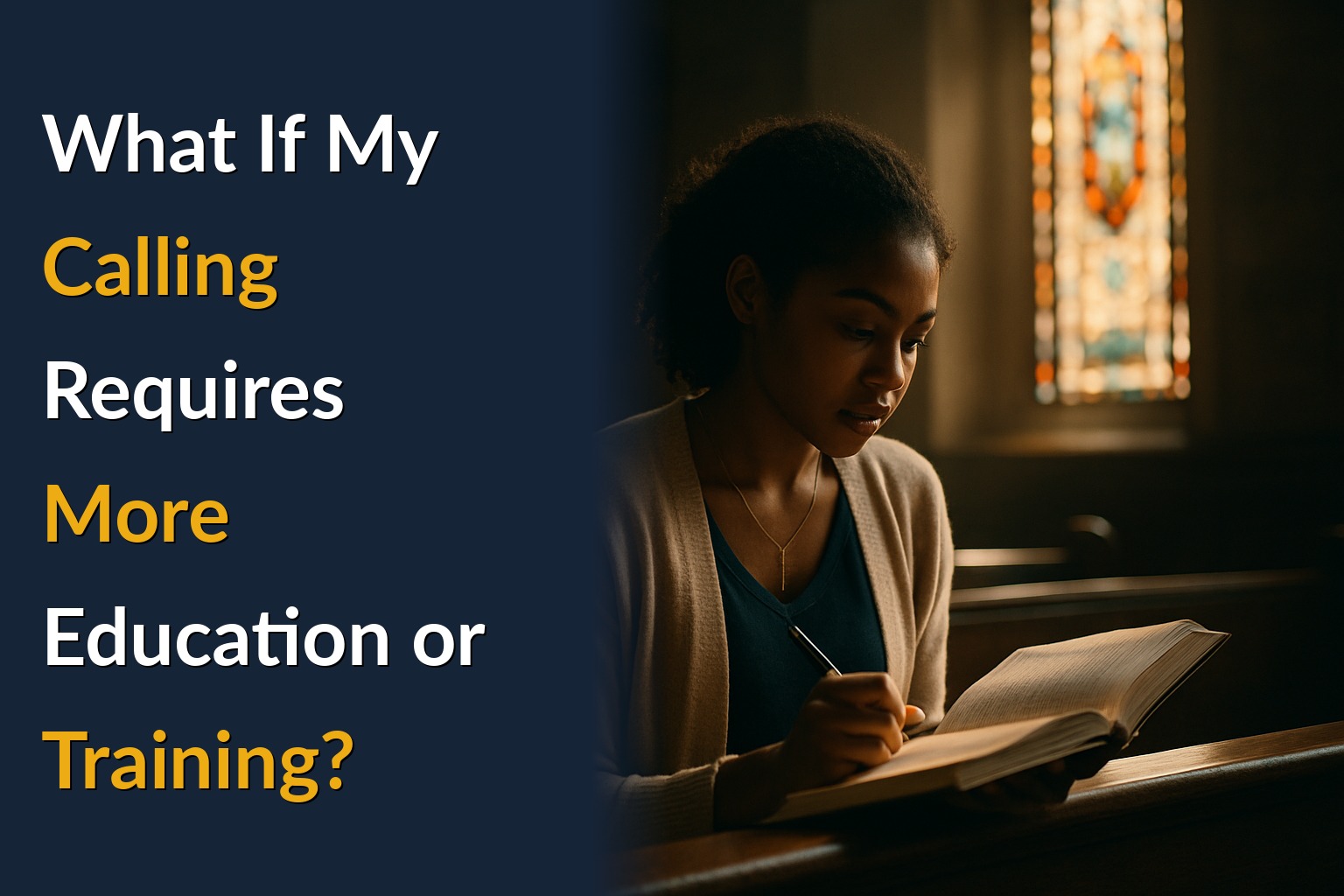
What If My Calling Requires More Education or Training?
Direct Answer: If your calling requires more training, get the training, but don't let it become an excuse to delay starting. Begin where you are while you grow, and let God open doors for the education you need along the way.
Have you ever felt like your calling is too big for your current skill set? Maybe you sense God stirring something in you, but you look at your resume, your degree (or lack of one), and think, "I'm not qualified for this."
That feeling is common, and it's not necessarily wrong. Some callings genuinely require specific training, licensing, or education. A doctor needs medical school. A counselor needs credentials.
But here's what trips up a lot of faith-driven entrepreneurs and leaders: they confuse needing more training with needing permission to start. Those are two very different things, and this post is about untangling them.
Why Does God Call People Before They're Fully Ready?
God calls people before they're ready because calling is about obedience, not credentials. Look at Moses, who stuttered his way into leading a nation, or the disciples, who were fishermen before they were world-changers.
God isn't looking for your resume. He's looking for your yes. Training often comes after the call, not before it, because the process of walking it out is part of how He equips you.
This doesn't mean training is unnecessary. It means the call usually comes first, and the preparation unfolds as you move.
What's the Difference Between Preparation and Procrastination?
Preparation has a plan and a deadline. Procrastination hides behind "I need to learn more" indefinitely, without ever setting a date to actually start.
Ask yourself: is this training genuinely required, or is it a comfortable delay tactic? If a specific license or degree is legally or practically necessary, that's preparation. If you're just afraid and calling it "research," that's procrastination wearing a disguise.
A good gut check: could you take one small step toward your calling today, even while pursuing more training? If the answer is yes, you're likely stalling more than preparing.
How Do You Know What Training You Actually Need?
You know what training you need by getting specific about your calling, not generic about your fears. Vague callings produce vague anxieties. Clear callings produce clear next steps.
If your calling is to coach people through financial stress, you may need certifications or at least real experience managing money well. If your calling is to write and encourage others, you likely don't need another degree, you need to start writing.
Clarity kills unnecessary fear. The more specific you get about what God is actually asking you to do, the easier it becomes to see what training is genuinely required versus what's just self-doubt talking.
If you're not sure how to answer those questions, that's exactly what the Kingdom Calling Profile is for. It's 8 questions, completely free, and at the end you get a personalized profile that names your passion, your burden, your audience, and what you're actually built to do.
👉 Discover Your Kingdom Calling, Free: https://discovery.kingdomlaunchpad.app?flow=short&utm_source=ryanreger-blog&utm_medium=organic&utm_campaign=calling-profile-launch
Can You Start Before You're Fully Trained?
Yes, in most cases you can start before you're fully trained, because calling often unfolds in stages. You don't need a finished product to take a faithful first step.
Think of it like building while walking. You can serve a small group, write your first article, mentor one person, or launch a simple version of your idea, all while continuing to grow your skills in the background.
Waiting for "fully qualified" is a moving target that never arrives. God rarely waits for perfect readiness, He works with willing hearts and grows the skill set as you go.
What Does the Bible Say About Training and Timing?
The Bible shows a consistent pattern of God preparing people through the process, not before it. David spent years as a shepherd before he became king, and those years in the field shaped him for the throne.
Joseph spent time in slavery and prison before stepping into leadership in Egypt. Paul spent years in relative obscurity before his ministry took the shape we read about in Scripture.
Training and timing are woven together, not separated into neat before-and-after boxes. Trust that the season you're in now, even if it feels like "just preparation," is doing real work in you.
How Do You Stay Faithful While You Wait to Be Ready?
You stay faithful by doing what you can with what you have right now. Faithfulness in small things is how God prepares you for bigger things.
Keep showing up. Keep learning. Keep taking the next visible step, even if it's small, even if no one is watching yet.
Delayed obedience isn't holiness, it's often just fear with better language. Move forward in faith, and trust God to fill in the gaps in your training as you go.
Frequently Asked Questions
Do I need a degree to pursue my calling? Not always. Some callings, like medicine or law, genuinely require formal education, but many faith-driven callings, like coaching, teaching, writing, or ministry leadership, are built more on experience, character, and obedience than on a diploma.
How do I know if my calling requires certification? Look at whether the field has legal, ethical, or safety requirements attached to it. If people's wellbeing depends on specialized knowledge, seek proper training. If it's more about sharing what you already know or have lived through, you likely need less formal training than you think.
What if I can't afford more schooling right now? Start with what's accessible: books, free courses, mentorship, and hands-on experience. God can absolutely use limited resources, and often the constraint pushes you toward creative, faithful next steps instead of waiting for ideal conditions.
Is it wrong to feel unqualified for my calling? No, feeling unqualified is common and even biblical. Many people God used throughout Scripture felt unqualified at first. What matters is whether you let that feeling stop you or whether you move forward in faith anyway.
How can I get clarity on what my calling actually is? The Kingdom Calling Profile is a great starting point. It's a free, 8 question tool that helps you name your passion, your burden, your audience, and what you're actually built to do, so you can figure out what training, if any, you truly need.
What if I start and realize I need more training later? That's completely normal and expected. Callings develop in stages, and it's common to start small, discover a gap, and pursue specific training as the need becomes clear rather than trying to prepare for everything upfront.
How long should I wait before starting on my calling? Generally, start as soon as you can take a faithful small step, even while continuing to grow. Waiting indefinitely for "full readiness" often becomes a way of avoiding the risk and vulnerability that comes with actually beginning.
If you're wrestling with this, I want you to know you're not alone in it. So many people I talk with carry this same tension between wanting to be ready and knowing God is calling them now.
Take the next small step. Trust Him with the rest. He's faithful to finish what He starts in you.